
 Kia Rio: Radiator: Inspection
Radiator Cap Testing
| 1. |
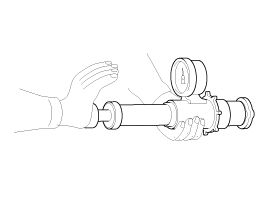
Remove the radiator cap, wet its seal with engine coolant, then
install it to pressure tester.
|
| 2. |
Apply a pressure of 93 ~ 123kPa (0.95 ~ 1.25kgf/cm², 14 ~ 19psi).
|
| 3. |
Check for a drop in pressure.
|
| 4. |
If the pressure drops, replace the cap.
|
Radiator Leakage Test
| 1. |
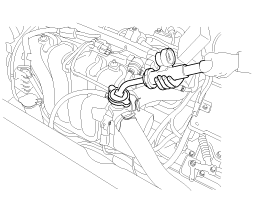
Wait until engine is cool, then carefully remove the radiator
cap and fill the radiator with engine coolant, then install a pressure
tester on it.
|
| 2. |
Apply a pressure of 93 ~ 123kPa (0.95 ~ 1.25kgf/cm², 14 ~ 19psi).
|
| 3. |
Inspect for engine coolant leaks and a drop in pressure.
|
| 4. |
If the pressure drops, check hoses, the radiator and the water
pump for leakage. If there is no leakage, inspect the heater core, the
cylinder block and the cylinder head.
|
| 5. |
Remove the tester and reinstall the radiator cap.
|

Fan Motor
| 1. |
Disconnect the fan motor connector from the resistor.
|
| 2. |
Connect the battery voltage to the "+" terminal and ground to
"-" terminal.
|
| 3. |
Check the cooling fan motor operates well.
|
 Radiator: Removal and Installation
1.
Disconnect the battery negative terminal.
Tightening torque
(-) terminal (without battery sensor):
7.8 ~ 9.8N.m (0.8 ~ 1.0 ...

See also:
Steering Column and Shaft Disassembly
Key lock assembly
1.
Make a groove on the head of special bolts (A) with a chisel.
2.
Loosen the special bolt using a screw driver a ...
Circuit Diagram
...
Ignition Switch Assembly Removal
1.
Disconnect the negative (-) battery terminal.
2.
Remove the steering column upper and lower shrouds.
(Refer to the ST group - & ...
Categories
- Kia Rio Manuals Home
- Kia Rio YB 2017-2026 Owners Manual
- Kia Rio YB 2017-2026 Service Manual
- Kia Rio UB 2012-2017 Owners Manual
- Kia Rio UB 2012-2017 Service Manual
- Downloads

Copyright © www.kirmanual.com 2014-2026