
 Kia Rio: ESC Control Module Removal
| 1. |
Turn ignition switch OFF.
|
| 2. |
Pull up the lock of the HECU connector (A), and then disconnect
the connector.
|

| 3. |
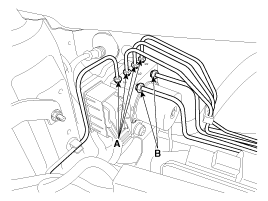
Disconnect the brake tubes from the HECU by unlocking the nuts
counterclockwise with a spanner.
|
| 4. |
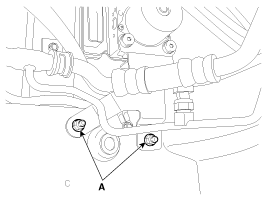
Loosen the HECU bracket nuts (A), then remove HECU and bracket.
|

| 5. |
Remove the 3 bolts, and then remove the bracket from HECU.
|
 ESC Control Module Components
1. Front - left tube
2. Rear - right tube
3. Rear - left tube
4. Front - right tube
5. MC2
6. MC1
7. ESC control module (HECU)
8. Damper
9. Bracket
...
 ESC Control Module Installation
1.
Installation is the reverse of removal.
2.
Tighten the HECU mounting bolts and nuts to the specified torque.
3.
...
See also:
Smart key unit Installation
Smart Key Unit
1.
Install the smart key unit.
2.
Install the smart key unit mounting nuts and connector.
3.
...
Inspection
1.
Inspect the check valve in the vacuum hose.
Do not remove the check va ...
Circuit Diagram
(M/T)
(A/T)
...
Categories
- Kia Rio Manuals Home
- Kia Rio YB 2017-2026 Owners Manual
- Kia Rio YB 2017-2026 Service Manual
- Kia Rio UB 2012-2017 Owners Manual
- Kia Rio UB 2012-2017 Service Manual
- Downloads

Copyright © www.kirmanual.com 2014-2026