 Kia Rio: TPMS Receiver Description
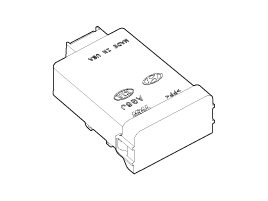
|
1. |
Mode
|
(1) |
Virgin State
| A. |
The receiver as a sole part is shipped in this
state. Replacement parts should therefore arrive in
this state.
|
| B. |
In this state, there is no sensor monitoring and
no DTC monitoring.
|
| C. |
The state indicates that platform specific parameters
must be written to the receiver and that sensors are
un-learned.
|
|
|
(2) |
Normal State
| A. |
In order for tire inflation state and DTC monitoring
to occur, the receiver must be in this state.
|
| B. |
In this state, automatic sensor learning is enabled.
|
|
|
(3) |
Test State
| A. |
This state is only used in manufacturing plant
to check RF transmission between sensor and receiver.
|
|
|
|
2. |
Overview
| A. |
Receives RF data from sensor.
|
| B. |
Uses sensor data to decide whether to turn on TREAD Lamp.
|
| C. |
Learn TPM sensor for under inflation monitoring automatically.
|
| D. |
Uses sensor information, distance travelled, background
noise levels, Auto-learn status, short / open circuit output
status, vehicle battery level, internal receiver states to determine
if there is a system or a vehicle fault.
|
|
As manual for diagnosis methods by using diagnosis device, the main contents
are as follows:
1.
Connect self-diagnosis connector(16pins) located in the lower
of driv ...
1.
General Function
A.
Auto-learn takes place only once per Ignition cycle.
B.
On successful compl ...

 TPMS Sensor Diagnosis procedure by using diagnostic device
 TPMS Receiver Operation